Product Title
- Grades: 6–12
- Number of Students: 4–5 students per kit
- Number of Lessons: 16
- Hours of Content: 5–13 hours
- Additional Resources: Teacher Guides, Student Guides, hands-on lab activities, user manual, data sheet, and curriculum materials.
Highlights:
- Combines solar, wind, hydrogen, and fuel-cell technologies.
- Demonstrates renewable-energy systems on a small scale.
- Includes hands-on experiments and project-based learning.
- Explores renewable microgrids and clean-energy generation
Curriculum or Lesson Topics:
- Solar and wind energy
- Hydrogen production and fuel cells
- Water electrolysis
- Energy conversion and efficiency
- Electric circuits and Ohm’s Law
- Redox reactions and stoichiometry
- Climate change and human impacts
- Renewable energy and sustainability
Standard Alignments:
-
NGSS: PS1.B – Chemical Reactions
-
NGSS: PS3.D – Energy in Chemical Processes
-
NGSS: ESS3.C – Human Impacts on Earth Systems
-
NGSS: ESS3.D – Global Climate Change
- Supports investigation, data analysis, mathematical reasoning, and engineering design.
What’s Included:
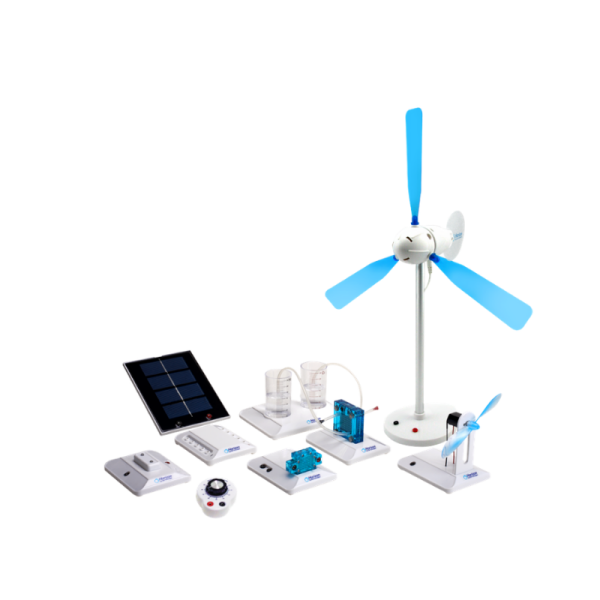
- Wind turbine with profiled and sheet blades
- 1-watt solar panel
- PEM electrolyzer
- PEM fuel cell
- Hydrogen and oxygen storage tanks
- Variable resistor module
- Battery pack
- Water/gas tank module
- Connecting leads and tubing
- Syringe, adapters, and assembly tools
- Assembly instructions and curriculum CD
Technology Requirements/Specifications:
-
Model: FCJJ-37
-
Recommended ages: K–12 / approximately 6–12
-
Dimensions: Approximately 17.3 × 13.0 × 4.3 inches
-
Weight: Approximately 4.5 lb.
- Requires distilled water and AA batteries for certain activities.
- An electric fan, stopwatch, ruler/protractor, and optional multimeter or Horizon Renewable Energy Monitor may be used for experiments.
Special Notes and Considerations:
- Designed for hands-on classroom and STEM laboratory instruction.
- Students can investigate solar, wind, hydrogen, and fuel-cell systems.
- Activities can be completed individually or in small groups.
- Teacher supervision is recommended, particularly during assembly and electrolysis activities.
- Some experiments require additional classroom materials such as distilled water, batteries, or an electric fan.