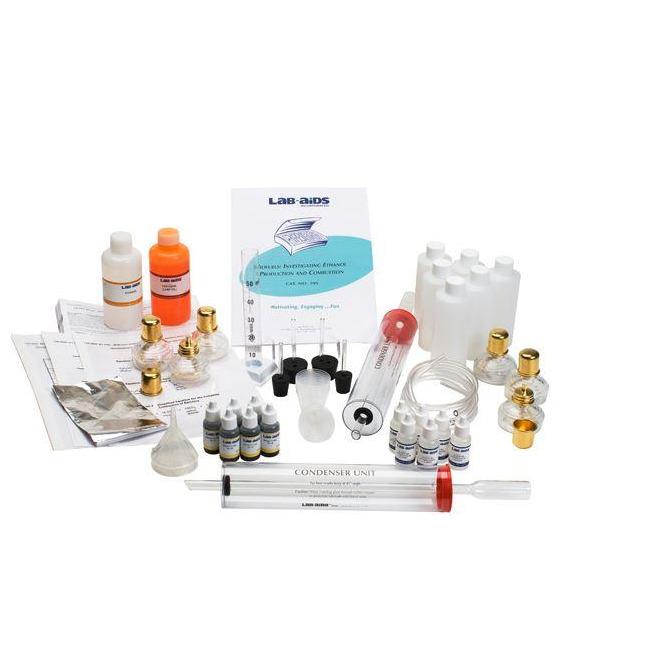
Lab-Aids:‚ Biofuels - Investigating Ethanol Production and Combustion Kit
This activity includes three major parts:
- Investigation One - is a demonstration of the fermentation of corn and cane sugar, the two food sources used most commonly to produce ethanol, and the distillation of the fermented stillage to produce fuel‚
- Investigation Two - students investigate the energy released by the combustion of ethanol and kerosene and compares the results‚
- Investigation Three - students measure and compare two by-products - CO2 and particulute matter - of the two fuels. Students compare results and discuss the trade-offs of bio-fuels and fossil fuels as sources of energy
Science Concepts:
- Chemical reactions that release energy, such as the burning of fuels, occur all around us
- Students conduct scientific investigations, use mathematics to improve investigations, and formula models using evidence
- Human resource consumption places stress on the natural processes that renew some resources and depletes those resources that can not be renewed
- Decisions about new research and technology, such as those related to energy issues, involve assessment of alternatives, risks, costs, and benefits. Students should understand the costs and trade-offs of various decisions
Content List:
- 1 Teacher„¢s Manual with MSDS
- 28 Student Worksheets and Guides
- 12 30-mL graduated cups
- 6 Glass fuel burners
- 6 Pieces of aluminum foil
- 6 180-mL plastic bottles with caps
- 6 15-mL dropper bottles with bromthymol blue solution (BTB)
- 6 15-mL dropper bottles of 0.05 M sodium hydroxide (NaOH)
- 3 45-cm pieces of clear plastic tubing
- 2 LAB-AIDS‚® Condensers
- 2 1-holed #3 rubber stoppers (for condensers)
- 2 2-holed #7 rubber stoppers (for flasks)
- 2 plastic funnels
- 1 50-mL graduated cylinder with base
- 1 240-mL bottle of ethanol
- 1 240-mL bottle of kerosene
- 1 Transparency 1: Energy Results for Ethanol and Kerosene
- 1 Transparency 2: Combustion Equations
- 1 Transparency 3: Hydrocarbon Combustion
Classroom Planning:
- To complete this kit requires at least part of one ~50-minute class period for set-up, class time for observations and note taking for the several days of fermentation, one period for distillation, and a final period for small group investigations.
- Number of students: 24